Economic Justice and the Green Movement" was the title of the
22nd annual conference of the Council of Georgist Organizations held
August 21-25, 2002 in London, Ontario, Canada. John Fisher, chairman
of the Ontario/Quebec chapter of Common Ground-USA, and his fellow
Canadians put together a superb program, and selected speeches will
be printed in later issues of GroundSwell.
Working with Council of Georgist Organizations Vice. Pres. Alanna
Hartzok, Ontario host John Fisher used his connections to the Green
Party to find speakers to address potential economic and
environmental relationships between the Green Party activities and
the Georgist movement goals. (Fisher was the Green Party Member of
Parliament candidate in his Elgin-Middlesex-London riding in year
2000); Hartzok was the Green Party candidate in year 2001 for US
Congress from her Pennsylvania district).
Frank de Jong, the leader of the Green Party of Ontario, Canada,
addressed the conferees at the banquet Saturday evening, Aug. 24. He
was introduced by attorney Frank Peddle from Ottawa, Ontario, who is
President of the Robert Schalkenbach Foundation of New York City and
who is a member of the Ontario/Quebec chapter of Common Ground-USA.
De Jong has been been elected since 1986 to serve as the
Spokesperson for the Green Party of Ontario.
De Jong was the principal spokesman and main coordinator of the
Candian Green Party election campaigns in 1995 and 1999. He was
active in the 1980s anti-nuclear activities and is active in
sustainable forestry and organic agriculture activities. De Jong
received his degree in music from the University of Western Ontario
and is an elementary school teacher. He also is a member of the
Ontario/Quebec chapter of Common Ground-USA.
De Jong addressed four topics during his speech at the conference
banquet: 1) The Green movement and the Green Party. 2) The
Simultaneous Policy Initiative promoted in a book by John Bunzl from
the United Kingdom, where churches, policy individuals, politicians,
academics, etc., would register to simultaneously cease some
activity, all to act on the same day everywhere. Unless all
countries agreed to act on the matter simultaneously (i.e., shut
down tax shelters, levying a Tobin tax on currency exchanges,
banning nuclear weapons, levying fees on unearned income), others
don't have to. 3) Green economics. 4) The relationship between the
Georgists and Greens.
Some of the deJong's comments follow.
The Green Party is in its fourth decade, though its roots go
back to Aldo Leopold and Thoreau. In the 1960s the Hippie movement
centered on rejection of the consumer culture. That collapsed, but
popped up in the 1970s in health food stores, in the peace
movement, in the womens' movement, in the wind turbine groups, and
environmental activists. Then, though disjointed, this time they
had an economic base and they had a structure. So in the 1980s,
coalition building emerged, in the Canadian Peace Alliance, in the
Voice of Women, in the Canadian environmental movement, in the
Canadian Wind Energy Association, and in the Solar Energy Society
of Canada. Disappointed at not being able to make a bigger impact
on political leaders, they decided to go "whole hog",
and roughly in the 1980s they started a political party to
challenge the powers that be at the ballot box.
The Green Party basically started in New Zealand with the
Values Party in the 1970s. In Eastern Canada it was called the
Small Party after "Small Is Beautiful". In England they
had the Ecology Party which they later named the Green Party.
Germany was where the Greens first came to international stature.
In Germany, the four pillar groups were Women, Peace, Ecology, and
Social Justice, which got together and they attained five percent
of the vote.
Green economics means what you have to do in the economic
system so that humans can live in balance with nature. There are
five green components to address in economics. We need alternative
economic indicators. The GDP (gross domestic product) doesn't know
how to add and subtract. We need a social and ecological portion
along with the fiscal quotient. Merge those three and then you get
the genuine progress indicator. Now when government wants to pay
off fiscal debt, they grind up some more nature or trash a few
more communities, thus deepening the ecological and social debt to
pay off the fiscal debt. We need a Green economics mechanism and
tool box to make sure we can keep those debts in check. The
rationale for Green economics is full cost accounting. The ticket
price has to reflect the true cost of the product. When you buy a
pound of coffee, you can pay two bucks for regular monoculture
coffee grown where a couple of thousand people were evicted from a
rain forest, or you can pay $8 to $12 a pound for coffee from
shade grown, fair trade, organically grown coffee.
We have to go through every aspect of society to do that kind
of full cost accounting numbers crunching. A standing forest has
no worth, but when you cut it down, somebody gets rich. When that
is gone, we are poorer. We need to add the moral side to
economics. How do you monetize things -- air, water, endangered
whooping cranes, etc.? Once we have our alternative cost
accounting green indicators in place, we can start doing some real
green economics. We can increase the list of sin taxes of alcohol
and tobacco to add higher taxes on eco-sins -- things that are
destroying our planet and our health (pesticides, fossil fuels,
etc.) In the meantime, you have a tax free list: bicycles, solar
equipment, musical instruments, books, non-motarized recreational
vehicles. In Canada we have a 15% consumption tax, of which half
is provincial and half is federal. When you buy virgin paper at $4
a ream, it is an uneven playing field with when you pay $10 to $12
for recycled or recovered paper.
The cornerstone of Green economics, aside from the land value
taxation idea of Henry George, is the Green tax shift, which is
very accessible and people understand that. It means "tax
bads, not goods," or "Tax resources, not incomes."
The rationale is that industry always follows the path of least
tax resistance. Industry doesn't deliberately start out to grind
up more nature, but they focus on providing a product and paying
the payroll, and providing for the shareholders.
The business people are morally neutral on destroying the
planet or not. In the Green tax shift, put taxes on the good stuff
and industry will follow. We need to educate, tax, and then
legislate. Educate as to what is right and what is wrong, and then
we apply the green taxes to move a lot of industry in the right
ways, and then legislate to clean up the recalcitrant folks who
refuse to do what is "good for them".
Community economics means we have to survey the community,
formally and informally, and figure out what services your
community can provide and what are the goods and services that
your community needs. Then match them up. When a Walmart or
McDonalds comes to your community, currency leaves your community.
When you think of community economics, think of a bathtub. When
the bathtub is full of water, everybody is happy, but when the
bathtub has too many leaks, like with a McDonalds or a Walmart,
you have to keep pouring more water into the bathtub. You end up
hurting your education and health care system in order to have a
bathtub of water, instead of plugging the hole in the bathtub by
getting rid of Walmart or McDonalds. Go to the local furniture
maker, and the profit stays in the community and you have social
cohesion.
The fourth thing is how the Georgist movement can impact not
only the Green Party but all kinds of other organizations. The
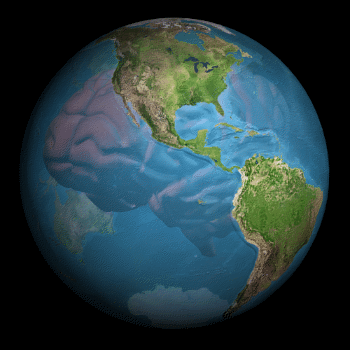
Georgist movement is brains without a body. The Green Party and
lots of organizations like it are bodies without brains.
Environmentalists can work for days on growing organic veggies,
but if you don't understand the economics of agriculture, you are
lost. The determining factor in organic agriculture is the amount
of labor that you put forth. In petro-chemical agriculture, the
determining factor is the amount of land, capital and pesticides
you have. That is the same for forestry. The determining factor
for organic or collective forestry is the amount of labor,
selective logging or allowing small amounts of forestry to grow
wild. If you do the math of transportation, bicycles are faster
than cars. Figure out how much time it takes to save up money to
buy the car, how much time it takes to save up money to spend on
roads through taxes. If you add it up, you don't have to spend all
that time at work earning enough money for the car.
The Georgists can help other people and organizations by
providing a vision of how to get out of this mess. Our agriculture
system is seriously flawed, our forestry sytem, our economic, our
schools, our health care are in danger of collapse, our eco-system
and our whole biosphere -- the environmental refugees now exceed
the economic or victims of war refugees. We have very serious
problems. How do we get out of this mess? Learning the Georgist
economics is indeed the way out for myself and other people. We
have to press our ideas onto the general public and certainly on
decision makers. Kick at the darkness until it bleeds daylight,
and that is what Greens, and Georgists and thousands of other
folks have to do.